
Boost Retention: 10 Subscription Churn Reduction Strategies for Mobile Apps

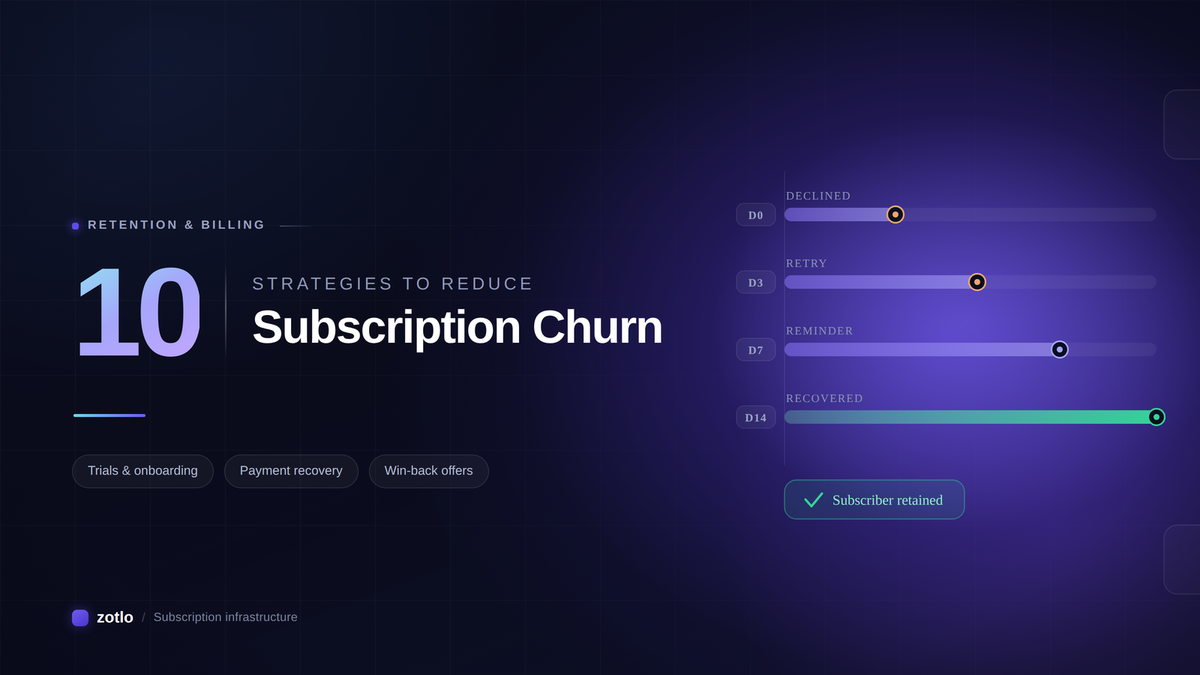
Most subscription apps lose users before they arrive. RevenueCat's 2026 data shows most trial cancellations happen on day zero, and over a third of annual subscribers switch off auto-renewal within a month. App churn is silent; cancellations happen inside app store settings, not your product. This guide covers subscription churn reduction strategies for voluntary and involuntary churn, framed around one question: is billing on your store or your web checkout?
The ten strategies at a glance:
- Win day zero before you win the month
- Set trial length deliberately, not defensively
- Match plan duration to how your users actually behave
- Learn from cancellation reasons instead of guessing
- Build win-back into the lifecycle
- Configure store-side payment recovery properly
- Run smart dunning on your web billing
- Deploy card updaters and pre-dunning
- Localise payment methods and pricing for your growth markets
- Consolidate your subscription stack
Understanding Subscription Churn Reduction Strategies
Most churn advice fails for one structural reason: it treats churn as a single problem. It is two problems that share a metric, and the fixes have almost nothing in common. This holds whether you're running a SaaS platform, a marketplace, or a mobile subscription app; the mechanics of voluntary and involuntary churn don't change with the product category.
What is Customer Churn? (Voluntary vs. Involuntary)
Voluntary churn is a decision. The user opens their subscription settings and turns off auto-renewal — because the app did not deliver what the paywall promised, because they forgot it existed, or because the value was seasonal and the season ended. The cancellation and the churn are separate events: someone who cancels on day three of a monthly plan keeps access until day thirty, so by the time revenue moves, the decision is nearly a month old.
Involuntary churn is an accident. The user decided nothing. A card expired, a bank declined the renewal, a stored payment method went stale. On Google Play, involuntary cancellations account for over a third of all cancellations, according to Google's own developer data. The App Store runs meaningfully lower, largely because billing retry is always on and Apple surfaces billing problems natively.
Voluntary churn is a signal about your product, paywall, or pricing. Involuntary churn is pure leakage — you lose a satisfied user, and the money was already earned. The same pattern shows up in SaaS billing. A declined card doesn't mean the customer left; it means the charge failed.
Where You Bill Decides What You Can Fix
One structural point governs how much of your churn is addressable at all.
When a subscription is billed through the App Store or Google Play, the platform owns the relationship. It holds the payment method, sends the renewal notice, runs the retry schedule, and handles the cancellation. You get server notifications describing what already happened, plus a small set of configuration switches. You typically do not have the subscriber's email address, cannot choose which payment methods appear in a given country, and cannot change how a failed renewal is retried.
Billed on your own web checkout — a web-to-app funnel, a web upsell, or a full direct-to-consumer flow — every one of those levers moves to you: the payment credential, retry timing, dunning sequences, pre-renewal notices, local payment methods, and a direct channel to the subscriber.
That is not an argument that web billing is simply better; refunds, billing support, tax, and consumer-protection compliance come with it, and off-platform checkout converts less easily than a native purchase sheet. The point is narrower: the share of your churn you can actually act on is largely determined by where the payment happens.
How to Calculate Your Churn Rate: A Simple Formula
Customer Churn Rate = (Subscribers Lost During Period ÷ Subscribers at Start of Period) × 100
You begin March with 8,000 active subscribers, and 620 subscriptions end during the month. Your monthly churn rate is (620 ÷ 8,000) × 100 = 7.75%.
Two rules keep this honest. Exclude subscribers acquired during the period from both sides, or new installs will flatter the number. And run the same formula on revenue, since losing a hundred weekly subscribers and losing ten annual ones look similar in a customer count and nothing alike in MRR.
For apps, add two views that the formula alone does not give you. Renewal rate by plan duration, because weekly, monthly, and annual plans have completely different retention curves and blending them averages away the only thing you could act on. And involuntary churn, calculated separately — both stores report the split, and if the number is material, payment recovery is fixable in days rather than quarters.
Benchmarks orient; they do not grade. RevenueCat's 2026 data shows lower-priced apps retaining better on annual plans (around 36%) than high-priced ones (around 23%), and AI-powered apps churning roughly 30% faster despite generating around 41% more revenue per payer.
The Top 5 Reasons Subscribers Churn
Voluntary and involuntary churn split the problem in two, but only one side starts with a decision. Before separating the fixes, it helps to name what actually drives that decision:
- Poor onboarding experience. The user hit the paywall before understanding what they were buying, or subscribed and never reached the moment the app became useful.
- Lack of perceived value. The app works, but the user cannot articulate what the recurring charge is for — lethal at renewal, when the store's notification forces a conscious re-evaluation.
- Ineffective customer support. Billing questions that go unanswered become cancellations, refund requests, or one-star reviews.
- Pricing and plan issues. The user wanted a cheaper tier or a shorter commitment and found only a cancel button.
- Failed payments (involuntary churn). An expired card, a declined renewal, a recovery window that closed before the user noticed.
The first four require product, pricing, and people. The fifth requires configuration and infrastructure — and it is by far the fastest to fix.
Proactive Strategies to Combat Voluntary Churn
Each of those five reasons points back to something within reach — onboarding, communication, pricing. The following five strategies work through them in the order they tend to matter most.
1. Win Day Zero Before You Win the Month
If most trial cancellations happen on day zero, then day zero is not the top of your retention funnel. It is the whole funnel.
Two decisions matter most: what happens before the paywall, where users need enough of the product to want it, and what happens immediately after purchase, which most apps neglect entirely. A subscriber who pays and lands on the same empty home screen has been given nothing to justify the charge.
Design the first session around one completed action that demonstrates core value — one generated result, one logged workout, one finished lesson — then compare the day-zero behaviour of subscribers who renewed against those who cancelled immediately. The action that separates them is your activation metric.
Paywall model matters less than teams assume. Hard paywalls convert around five times better than freemium on download-to-paid by day 35 (roughly 10.7% against 2.1%), but with nearly identical retention after one year.
2. Set Trial Length Deliberately, Not Defensively
Nearly half of subscription apps run trials of four days or fewer, assuming a short trial forces a faster decision. Often it forces a faster cancellation instead, because the user has not yet had a reason to open the app twice.
The right length is a function of how long your product takes to prove itself. A photo editor can do it in one session; a language app or fitness programme needs the user to come back, and a three-day trial ends before the habit forms. Test it against retention at day 60 and day 180, not trial-to-paid conversion alone, which will always favour the shortest option.
3. Match Plan Duration to How Your Users Actually Behave
Plan duration is a retention lever, not just a pricing one, and the curves differ enough that treating them alike is a mistake.
Weekly plans front-load churn: most of the loss happens at the first renewal, but subscribers who survive that week jump sharply in loyalty at the second. If you sell weekly, your entire retention programme belongs in the first seven days. Annual plans do the opposite and hide their churn — revenue is banked while a third of those subscribers switch off auto-renewal in month one, so annual retention work belongs at the start of the term rather than before the renewal date. Offer the durations your usage data supports rather than all of them by default, and build a distinct plan for each one you keep.
4. Learn from Cancellation Reasons Instead of Guessing
Cancellation is the most honest moment in the relationship, and in apps it is the least visible — the user cancels inside the store, where you are not present.
Both stores expose cancellation reason data in their consoles: coarse, but free and directional. Better, catch the intent earlier. Subscribers who cancel auto-renewal keep access for the rest of the term, and server notifications tell you the moment it happens — a window often weeks long, and the best in-app survey opportunity you will get. Ask three or four tight options plus a free-text field, then route the answers into a monthly review with product and growth in the room.
5. Build Win-Back Into the Lifecycle
A churned subscriber is a warmer prospect than a cold install, and considerably cheaper. Apple surfaces win-back offers in the App Store and inside your app; Google Play supports win-back and re-engagement offers for lapsed subscribers. Both work better tied to something specific — a feature the user asked for in the cancellation survey, a content update — than as a blanket discount fired at everyone who ever left. An attempt on the day access ends lands while the decision is fresh; the same offer at thirty or sixty days performs measurably better.
This is also where the billing channel shows up in voluntary churn. Store-billed subscribers can only be reached through the store's offer mechanics and whatever push permissions you were granted. Web-billed subscribers gave you an email address at checkout, so win-back becomes a campaign you run rather than a feature you request.
Automated Solutions for Involuntary Churn
Involuntary churn is a technical problem with technical solutions, and unlike onboarding work, it pays back in weeks. These subscribers already chose you — the payment simply has to go through. This is also where the store-versus-web distinction bites hardest: store-side recovery is a handful of switches you should absolutely turn on, but they are the ceiling of what you can do there.
6. Configure Store-Side Payment Recovery Properly
This is the cheapest revenue in the article, and a surprising number of apps leave it on the table.
On Google Play, a declined renewal enters a grace period (the user keeps entitlement while Google retries and prompts them) and then an account hold (access suspended, retries continue). Google's own figures show developers using both recover roughly three times more declined renewals — from around 10% to around 33% — and that grace periods alone deliver about a 57% higher recovery rate.
Since Google's December 2025 policy change, the total window is capped at 60 days, with account hold auto-calculated as 60 minus your grace period, and grace periods now default to up to 30 days. Add the In-App Messaging API call so users see the prompt when they open your app.
On the App Store, billing retry runs automatically and since iOS 16.4, Apple shows a billing problem message without any work on your side. Opt into the Billing Grace Period in App Store Connect and set it to its maximum — Apple's data indicates around 90% of billing issues resolve within a 28-day window.
Total implementation time for both: about an hour.
7. Run Smart Dunning on Your Web Billing
Where you bill directly on the web, you inherit the entire recovery problem — and the ability to solve it far better than a store can. A store gives a declined subscriber a fixed retry schedule and a generic notification. On web billing, you decide when to retry, what to say, and through which channel — which is why recovery logic is one of the first things worth evaluating in any subscription management solution you consider.
The difference between poor and good dunning is intelligence in the retry logic, because not every decline means the same thing:
- Insufficient funds is a timing problem — retrying the next morning fails again; retrying near common payroll dates succeeds far more often.
- Do not honour is an issuer decision that usually needs the user to contact their bank; aggressive retries can entrench the block.
- An expired card cannot be retried into success at all. It needs updated credentials.
- Fraud flags on recurring charges often clear once the user confirms the transaction with their bank.
Remember your audience is on a phone: a recovery email linking to a desktop-oriented billing page will not convert. One sentence explaining what happened, one tap to update the card, and a push notification alongside the email will.
8. Deploy Card Updaters and Pre-Dunning
Cards expire on a predictable schedule. Users, reliably, do not update them.
Account updater services — Visa Account Updater and Mastercard Automatic Billing Updater — solve this at the source: when an issuer replaces a card, the updated credentials propagate to enrolled merchants automatically and the renewal simply succeeds. Enrolment is managed at the acquirer and processor level, with coverage varying by network, issuing bank, and country, which is why access depends on your billing infrastructure rather than your code.
Pre-dunning handles what the updater cannot: a reminder before a stored card expires, a renewal notice ahead of a large annual charge, a prompt for users whose payments have failed before. These prevent failures rather than chasing them, and an advance renewal notice is now a regulatory requirement in a growing number of markets.
9. Localise Payment Methods and Pricing for Your Growth Markets
The most overlooked source of involuntary churn is the payment that never had a fair chance. A card issued in Turkey, Mexico, or Brazil processed through a single cross-border acquirer faces materially higher decline rates before anything about the user enters the picture — and those declines look exactly like churn in your dashboard.
This matters more than it used to, because the growth is no longer in the markets you optimised for. RevenueCat's 2026 data points to Japan, Mexico, and Turkey among the fastest-growing subscription markets. Three fixes, in order of impact: local acquiring, so transactions route through an acquirer in the user's own market; local payment methods, since a subscriber paying by domestic wallet or bank transfer is never exposed to card expiry at all; and local currency pricing, which removes the foreign-transaction fee that turns a satisfied subscriber into a cancellation.
10. Consolidate Your Subscription Stack
Every strategy above eventually runs into the same question: which tools actually carry it out. That question comes down to three routes.
Store billing only works well until you need to influence anything: recovery is a set of switches, payment methods are whatever the platform supports locally, and analytics stop at the console. There is no web channel to optimise.
A payment service provider (PSP) plus a dunning tool is the route most apps take when they add web billing — process through a PSP, then bolt on a dedicated recovery layer. Tools like Churn Buster, Churnkey, FlexPay, and Butter Payments do this well, though almost all of them were built for Stripe-based SaaS and ecommerce rather than for apps. What the combination does not solve is everything underneath it.
The recovery layer can only act on what the PSP gives it — decline-code detail, retry control, network token support — so how smart your dunning actually gets depends on the processor beneath it. You also still hold the acquiring relationship, which caps authorisation rates at your PSP's footprint; account updater access depends on what that PSP exposes, and tax registration, refunds, and consumer-protection compliance in every market remain yours. You are also reconciling two systems that hold different halves of the same picture.
An all-in-one merchant of record platform closes that gap: processing, retry logic, credential updating, local acquiring, local payment methods, and analytics in one system, with seller-of-record and tax responsibility moving off your side. The retry engine sees the decline code, the payment history, and the updated credential at the same moment.
Frequently Asked Questions About Subscription Churn Reduction Strategies
What is a "good" churn rate for a subscription app?
It depends far more on plan duration and category than on any universal benchmark. Weekly plans lose most subscribers at the first renewal, then stabilise sharply; annual plans look healthy for months while auto-renewal is quietly switched off. Compare against your own trend and plan mix, not a single industry number.
How is churn rate different from retention rate?
They are two views of the same period — retention measures who stayed, churn measures who left, and in their simplest forms they sum to 100%. For apps, renewal rate is usually the more actionable framing, because it is measured per plan duration rather than blended across your whole base.
Can you completely eliminate customer churn?
No, and chasing zero is a misallocation. Needs change, seasons end, and a share of every install cohort was never a good fit. The realistic goal is eliminating preventable churn — the user who never reached first value, the one whose billing question went unanswered, the one whose card expired inside a recovery window you never configured.
What is the difference between customer churn and revenue churn?
Customer churn counts subscribers; revenue churn counts money. In apps, the gap is often wide, because plan durations and price points vary so much across one user base.
How can a Merchant of Record (MoR) help reduce churn?
An MoR becomes the legal seller of record for your web transactions, taking on payment processing, tax compliance, and the acquiring relationships. For churn, that has three practical effects on the web side: direct acquirer relationships in multiple markets mean renewals a single cross-border processor would decline get approved; merchant-level access to account updater programmes means expired cards refresh automatically instead of becoming cancellations; and because processing, retry logic, and subscription data sit in one system, dunning decisions are made with full context.
For apps building a web-to-app funnel or a direct web checkout alongside store billing, this is where involuntary churn is won or lost. See how Zotlo recovers failed payments and keeps subscribers renewing →